Translate

Saturday, 17 January 2015

Xiaomi Launches Xiaomi NOTE and Xiaomi NOTE PRO - Xiaomi's answer to Apple's I phone 6 and I phone 6 plus ?


Xiaomi, the Chinese handset maker have launched their flagship phone's on 15th January 2015 , Xiaomi note and note pro which will be directly competing with rival flagship device's of Samsung, Apple and LG which have thier own flagship devices. So whether this new smart phone from Chinese handset maker would be able to competitive with them ?
Previous year Xiaomi was able to capture the mid-segment market and low segment market in Asia Sub-continent  with their Mi3 , Redimi note 1s and Redimi note 4 G but this year company has taken a step forward to enter the flagship segment or high-end segment with their recently launched product's .This high-end segment is  basically been ruled by the flagship devices of Samsung like Galaxy note 3 or 4, Apple's I phone 6 and 6 plus and LG's G3 devices.
And according to Xiaomi’s founder, CEO Lei Jun two Mi Note phones which he claimed will challenge iPhone 6 and 6 plus in looks, size and in camera quality. So, will it be able to do that ? Let's Check out the Specs  of both product Xiaomi note and note pro.
Xiaomi Note :


Display : 5.70-inch  Processor: 2.5GHz  Front Camera : 4-megapixel Resolution: 1080x1920 pixels  RAM:  3GB  OS: Android Storage: 16GB Rear Camera:13-megapixel
Battery capacity: 3000mAh  Price : CNY 2,299 (roughly Rs. 23,000) for the 16GB model 64GB model will be CNY 2,799 (roughly Rs. 27,900).

So Basically this device is running on Qualcomm's Snapdragon 801 which is pretty powerfull and most successful processor of Qualcomm, the company claims that this device is one of the beautiful devices been manufactured by them primarily because the body uses Corning's Gorilla Glass 3 with a 2.5D curve on the front and 3D curve on the back. The glass is supported by a sturdy metal frame with chamfered edges. The  5.7-inch screen dominates the front of the device and the bezels are thin, and  phone is 6.9mm thin, which actually undercuts the thickness of the iPhone 6 Plus by 0.2mm.
Xiaomi Note Comprises of a 4-megapixel front camera with 2-micron pixels, which is similar to HTC One M8, M7 and rear camera comprises of 13-megapixel rear camera with a Sony CMOS sensor, six-element lens, optical image stabilisation, and two-tone flash from Philips
On the bottom edge has the Micro-USB charging port (with Quick Charge 2.0 technology) and the speaker grille. The 3.5mm jack is housed on the top of the phone.Apart from this, the phablet supports LTE and has a 3,000mAh battery under the hood. There is 3GB of RAM and 16GB/64GB of storage space. On the software side of things, Xiaomi adds support for one-handed usage by allowing the screen to be shrunk.
Now we can say that this device will definately be choice of those who basically want a high-end spec devices under their budget.  We'll have to wait and see how this strategy pans out for a company known for its low-cost, high performance devices.

Xiaomi Note Pro:

Display: 5.70-inch, Processor:  octa-core, Front Camera:  4-megapixel, Resolution:  1440x2560 pixels RAM: 4GB, OS:  Android 4.4.4 , Storage: 64GB Rear, Camera: 13-megapixel, Battery capacity: 3000mAh, Price: CNY 3299 (approximately Rs. 32,900)

Xiaomi note pro is running on octa-core 64-bit Qualcomm Snapdragon 810 processor (quad-core ARM Cortex A57 and quad-core Cortex A53) alongside 4GB of LPDDR4 RAM and Adreno 430 GPU. Running Android 4.4.4 KitKat-based MIUI 6, the Mi Note Pro supports a single SIM. and the rest of the specification is same as on Xiaomi NOTE.

As per Xiaomi ,launch of the Both devices ( Xiaomi's Note and Note Pro) in India is in road-map of Xiaomi but no tentative date has been given by them, till then we have to just wait for the official launch of the device's in India.

Monday, 12 January 2015

Smart phones to be launched in year 2015

Saygus V2 
The phone with 320 GB memory (reality: 64 GB internal memory and SDXC slots of 128 GB and 128 GB), 5 inch Full HD display, 3GB ram with 2.5 GHz Qualcomm Snapdragon 810 with 13 m.p front camera plus 21 m.p rear camera

Kodak IM5
The huge popularity of smartphones finally brought photography accessory manufacturer Kodak into the ring. They released the Kodak IM5 smartphone which is powered by Android and features a 13 MP rear camera with auto-focus and a 5 MP front camera.

Samsung Galaxy E5, E7
The top smartphone seller of the world, Samsung, also launched two smartphones apart from several other significant releases this year. Focusing on mid-range and budget consumer segment they released Galaxy A7 and Galaxy A5 smartphones. Boasting of a 5.5-inch and 5-inch display, the smartphones released in India at Rs 20,500 and Rs 19,300.

Polaroid Selfie
Polaroid is another company that's slowly shifting from traditional camera-manufacturing to the world of smartphones. First, they released Social matic camera for social media addicts and now an all new smartphone, Polaroid Selfie. The smartphone looks almost identical to Oppo N1 and features the similar swivel camera. Apart from that, the smartphone features a 5.5-inch 720p display, octa-core MediaTek SoC and runs Android 5.0 Lollipop out-of-the-box.

Phones to be Launched in the year 2015

The phones that are to be launched in the coming year of 2015 had be shown in CES 2015. Some of the mobile that i came to know are as listed

1. Asus Zenfone 2 ZE551ML
2. LG G Flex2
3. HTC Desire 826
4. Asus Zenfone Zoom ZX550
5. Nokia 215
6. Lenovo Vibe X2 Pro
7. Lenovo P90
8. HTC Desire 320
9. ZTE Grand X Max+
10. ZTE Star 2

Saturday, 10 January 2015

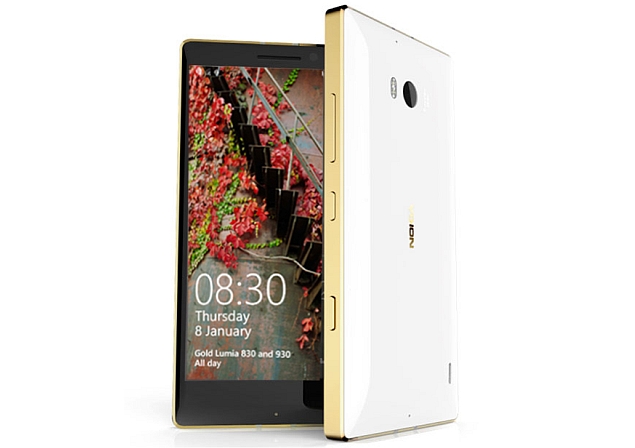
Microsoft's Nokia Lumia 830 and Nokia Lumia 930, which were launched last year flaunting aluminium frames with metallic accents, have now been re-launched with 'anodised gold colour' aluminium frame separately from CES 2015.
The Microsoft Lumia 930 Gold (seen below) and Microsoft Lumia 830 Gold (seen above) will reach select regions including Europe, Asia Pacific, the Middle East, Africa, and China. The India region will however only receive the Lumia 830 Gold only. While the Lumia 930 Gold will hit the shelves by the end of this month, the Lumia 830 will reach in February. The prices for the models are not yet known.
Microsoft has made it clear that the Windows Phone 8.1-based Lumia 830 Gold and Lumia 930 Gold models will be available in Black and White colour variants only.
microsoft_lumia_930_gold.jpg
Apart from the frame, everything else in both Lumia 830 Gold and Lumia 930 Gold stays the same, including the specifications. To recall, the Lumia 830 features a 5-inch HD (720x1280 pixels) ClearBlack IPS LCD display with pixel density of 296ppi; 1.2GHz quad-core Snapdragon 400 processor; 1GB of RAM; 10-megapixel PureView camera with LED flash; 1-megapixel front-facing camera; 16GB of inbuilt storage which is expandable up to 128GB (via microSD card), and 2200mAh battery.
The Lumia 930, which was unveiled back in April last year, features a 5-inch (1080x1920pixel) display with 441ppi pixel density, 2.2GHz quad-core Qualcomm Snapdragon 800 SoC; 2GB of RAM; 32GB of built-in storage; 20-megapixel PureView camera; 1.2-megapixel wide-angled front-facing camera, and 2420mAh battery.

Android 5.0 Lollipop adoption rate is so low it didn’t appear on Google’s distribution chart

Android 5.0 Lollipop has been out for almost two months now, but as you should know by this point, that doesn’t mean very many people are actually using it. Actually, according to Google’s new platform distribution numbers, even fewer people than expected are on the latest and greatest Mountain View has to offer. Lollipop didn’t even hit the 0.1% cutoff required to be represented in the data.
Once per month, Google aggregates data about the various Android devices that check into the Play Store. This data is turned into some nifty tables and graphs for the developer dashboard, which app makers can use to better target devices. The largest chunk of active Android devices this time is represented by Jelly Bean (all three versions collectively) at 46%, followed closely by KitKat at 39.1%. The oldest version still showing up in the data is Android 2.2 Froyo (0.4%), which is positively ancient by technology standards — it was released in May 2010.
The newest version of Android that runs on Google’s flagship devices is a smaller part of the Android ecosystem than a version released nearly five years ago. That’s certainly not ideal from Google’s perspective, but the data doesn’t lie. You have to give Google credit for providing this service for developers without any PR spin. By comparison, last year after about two months, KitKat was on 1.1% of devices, which still isn’t great, but it’s at least ten times more than Lollipop right now. So, what gives?
Dashboard
There are a few things going on in the data that might explain the absence of Android 5.0, not all of which are bad. First, we don’t know anything about the absolute number of devices out there. It’s possible there are more Lollipop phones and tablets right now than there were on KitKat this time last year — all we know is that they comprise less than 0.1% of the whole Android ecosystem.
That’s not to say Lollipop uptake has been great, though. The Nexus program really stumbled this year. The Nexus 6 is a great phone if you can find it, and you probably can’t. Even two months after the announcement, this device is out of stock constantly. Nexus phones have always been in high demand, but it’s clear Motorola and Google were not prepared for the rush this year. The usual influx of new software that usually hits the Play Store around the end of the year didn’t happen this time — it’s not a lot, but enough to show up in the data. There simply aren’t sufficient Nexus devices to go around, and the limited updates of unlocked phones and tablets aren’t going to compensate for that.
Interestingly, KitKat usage jumped in this month’s data. That’s likely an effect of people trading in their old phones for new ones over the holiday season. Most flagship phones are still waiting on their Lollipop update, so that’s not too surprising, but even budget phones are starting to ship with Android 4.4. This version is tuned to play nice with slower devices, which has led to a ton of high-quality inexpensive phones. Thankfully, cheap devices powered by the archaic Gingerbread version are in heavy decline in this data, probably because of KitKat’s better support for the budget end of the spectrum. This is a very good thing.
LP update
Slow adoption of Android is a fact of life, and things are still better now than they used to be. A slow start to Lollipop’s deployment isn’t the end of the world, and it doesn’t point to user discontent. Lollipop isn’t something people go out and buy, it’s delivered to them whenever an OTA is ready. Slow updates are sometimes cited as a potential downfall for Android, but year after year it keeps growing. The platform numbers are odd, but it’s not time to panic yet.
Source: http://www.extremetech.com/